


By Eddah Waithaka
Introducing a well-structured wealth tax in Kenya could generate more than USD 1 billion in annual revenue, a new study concludes, funds that could transform public service delivery and tackle rising inequality.
However, researchers warn the country must first build the necessary legal and administrative foundations to succeed where other nations have failed.
The Institute of Public Finance (IPF) disseminated the findings in a new paper, “Taxing Wealth: Can Kenya Get a Wealth Tax Right?” The report arrives amid a national debate on tax fairness, following the public rejection of the Finance Bill 2024 and against a backdrop of stark economic disparity.
The Inequality Imperative
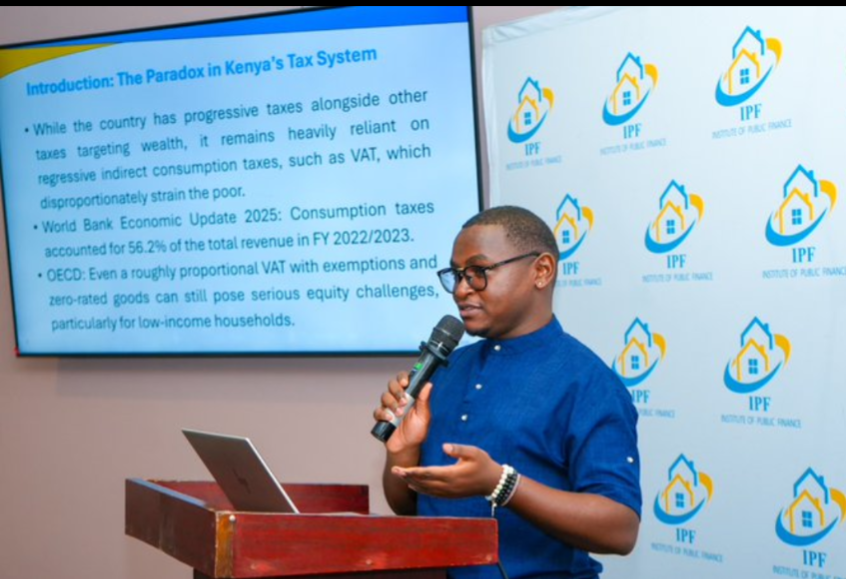
The research highlights a critical paradox in Kenya’s economy. While the country features progressive tax instruments, it remains disproportionately reliant on regressive consumption taxes like VAT, which place a heavier burden on low-income households.
“The top 10% of the population controls 62.8% of net personal wealth, while the bottom 50% collectively holds only 4%,” said Veronica Ndegwa, a Senior Research Analyst and Economist at IPF, during the report’s launch.
“Our public finance system has failed in redistributing wealth and in addressing inequality. This is not just an economic issue; it is about our social fabric, our stability, and the future of our country.”
The paper cites Oxfam estimates that a properly structured wealth tax could raise the significant sum of over USD 1 billion each year.
Crucially, the study does not call for an immediate wealth tax roll-out. Instead, it outlines a sequenced reform approach, identifying four interlinked challenges Kenya must address first: administrative capacity, legal frameworks, transparency, and political will.
“Kenya cannot tax what it cannot see,” emphasized Daniel Murakaru, IPF Legal Research Fellow, pinpointing the need for a comprehensive asset registry.
The paper’s key foundational recommendations call for establishing a centralised wealth database that integrates data from the Lands Registry, Companies Registry, KRA, and financial institutions to track assets like real estate and offshore holdings, strengthening cross-border data exchange by aligning with standards such as the OECD’s Common Reporting Standard to combat offshore tax evasion, launching a voluntary disclosure programme to incentivise asset declaration before a new tax takes effect, and harmonising existing taxes by immediately aligning Capital Gains Tax rates with the 30% corporate income tax rate.
Designing a Future-Proof Tax
Once preconditions are met, the report suggests a future wealth tax must be carefully designed to be fair, enforceable, and legitimate.
Proposals for a future Kenyan wealth tax include setting a high exemption threshold potentially around KES 129 million (USD 1 million) to shield the middle class, applying a modest, progressive tax rate between 0.01% and 3.5%, earmarking revenue transparently for universal healthcare, education, and social protection to build public trust, and implementing strong safeguards against capital flight and elite capture of the policy process.
“The implementation of a fair and effective wealth tax in Kenya is not beyond reach,” the report concludes. “However, realising this vision will demand deliberate policy design, institutional reform, and the political courage to prioritise the common good.”
The study positions the wealth tax debate as a pivotal opportunity for Kenya to reshape its social contract, urging a move away from volatile, unpopular tax measures toward a system where the wealthiest contribute their fair share to national development.
Read More Stories At: https://africawatchnews.co.ke/