

By Eddah Waithaka
A revolutionary free mobile application now connects ambulance systems across 12 Kenyan counties, enabling seamless coordination that promises to dramatically cut emergency response times and save thousands of lives when fully adopted nationwide.
The Ambulensi App developed by the Emergency Medicine Kenya Foundation, integrates county ambulance fleets through a single platform featuring real-time GPS tracking, intelligent dispatching, and instant patient information transfer.
“This platform monitors where ambulances are in real time and manages patient medical information during transit,” explains Dr. Gregory Ganda, Kisumu County’s CECM for Medical Services and Chair of the CECs Caucus, during an interview.
“We are here to see where we are as counties, learn what’s ideal, identify problems, and chart our way forward with national government.”
From Fragmented Fleets to Unified Command
Before Ambulensi, counties operated ambulances in isolation, vehicles belonged to specific facilities, creating coordination nightmares.
Kisumu pioneered the shift by pulling ambulances from individual hospitals into a central fleet under its Emergency Operations Centre.
“We had to politically get them out so ambulances belong to a fleet under pre-hospital service,” Dr. Ganda says. His county now dispatches 14 ambulances across sub-counties from a single command center.
The system empowers dispatchers to see all available ambulances in real time, identify the closest vehicle to any emergency, and track its movement from pickup to hospital delivery.
Emergency Medical Technicians document patient care digitally, giving receiving hospitals advance warning of incoming cases.
Free Technology, Minimal County Costs
The Ambulensi App carries no licensing fees, counties only need internet connectivity and staff costs to operate it. This low-barrier model accelerates adoption across resource-constrained counties.
“We used to do all our activities the way we normally do it, but they came in and assisted us in thinking through processes, setting standards, and establishing policies,” says Joshua Jarha Kofa, Tana River County’s CECM for Health, during an interview.
His county spanning 38,000 square kilometers with under 500,000 residents and seasonal floods became one of the first to develop a comprehensive EMS policy.
The foundation reports over 20 counties have now developed pre-hospital care policies, and 32 counties include emergency healthcare in their budgets.
Proven Success in Pilot Counties
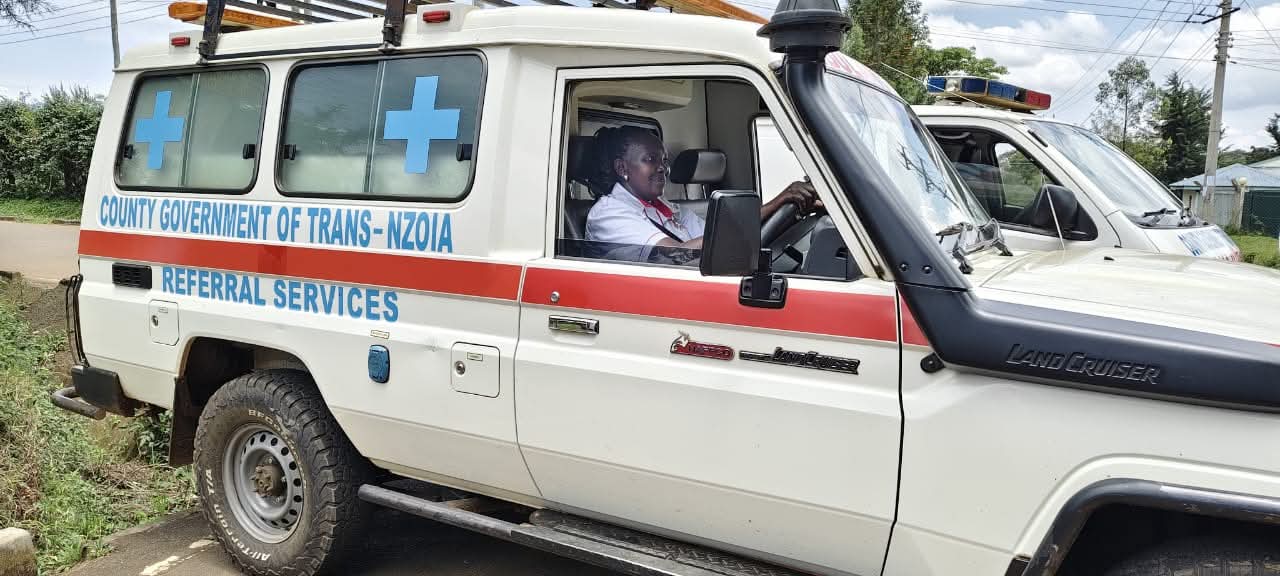
Trans Nzoia County recently established its Emergency Medical Dispatch Centre at Wamalwa Kijana Teaching and Referral Hospital, powered by Ambulensi. Residents now access services through toll-free number 0800 724 994.
“The system ensures the nearest available ambulance deploys quickly and efficiently,” notes a foundation statement. “Every second counts enhancing accountability, transparency, and communication throughout emergency response.”
Kilifi County uses the platform with support from Malteser International, installing central dispatch software with GPS tracking while training dispatchers and drivers.
Taita Taveta recently completed similar training, joining Kilifi, Turkana, Nakuru, Nyeri, and Siaya in implementing the Ambulensi model.
Kericho County established its dispatch centre at the county referral hospital, staffed by two dedicated nursing professionals, and operates a toll-free number residents easily remember: 0724 035 035.
“The longest you take to reach a victim in the periphery is about an hour,” says Dr. Ekuwam David, Kericho’s CECM for Health Services. “We get to the client within that time, then take them to the nearest sub-county facility.”
National Rollout Gains Momentum
The timing proves critical. Health Cabinet Secretary Aden Duale announced the National Ambulance Response System goes live December 1, featuring a toll-free hotline integrated with the Social Health Authority.
The system will automatically identify callers’ locations using digital tracking tools and dispatch the nearest available ambulance.
SHA will cover Ksh4,500 for evacuation within 25 kilometers and provide the first 24 hours of emergency care free for all citizens regardless of registration status.
Patients with SHIF coverage continue receiving care afterward.”The system will run through a centralised call and dispatch centre equipped with technology to track ambulance movement in real time, monitor response times, and coordinate referrals to the nearest appropriate health facility,” Duale told parliament.
Transforming Emergency Access
For counties like Tana River, coordinated dispatch revolutionizes emergency care. Community Health Promoters identify patients needing hospital referrals, and dispatchers determine appropriate facilities based on condition severity.
“We know where the health provider is and how this problem can be solved in that area,” Kofa says. “You don’t have to move all the way.”
He cites a recent example, during Tuesday’s rains, a mother experienced delivery complications. The dispatch system directed appropriate resources without sending her to the farthest hospital.
Technology Meets Local Knowledge
While the app provides powerful tools, county officials emphasize blending technology with community knowledge. Villages like Ndingopanga in Kisumu do not appear on Google Maps, so local dispatchers who know the terrain prove essential.
“There are places where technology will not help you,” Dr. Ganda acknowledges. “That’s why health is a devolved function you have somebody who knows that region and can say that mother is coming from this place.”
The system uses GPS coordinates from callers’ phones where available and maps all health facilities, allowing dispatchers to coordinate care from the nearest facility when exact locations remain unclear.
Building a Culture of Emergency Response
Kisumu’s health department now collaborates with education officials to integrate emergency awareness into school curricular, building a culture where even children know how to summon help.
“Pre-hospital care has been an ignored part of this country,” Dr. Ganda says. “Care starts from the place where you are and continues in the ambulance. The ambulance is just a moving hospital until you reach the other side.”
What Full Adoption Would Mean
If all 47 counties adopt Ambulensi, the public will access the shortest possible response times, dramatically reducing deaths from road accidents, maternal complications, heart conditions, and other emergencies.
“We are creating a Kenya where no one dies for lack of timely emergency care,” the foundation declares.
Emily Nyagaki, Director of Programs and Government Relations at the Emergency Medicine Kenya Foundation, confirms the momentum, “We have 12 counties with dispatch centres coordinating pre-hospital services. Over 20 counties have developed policies around pre-hospital care, and 32 counties have started including emergency healthcare services in their county budgets.”