


By Eddah Waithaka
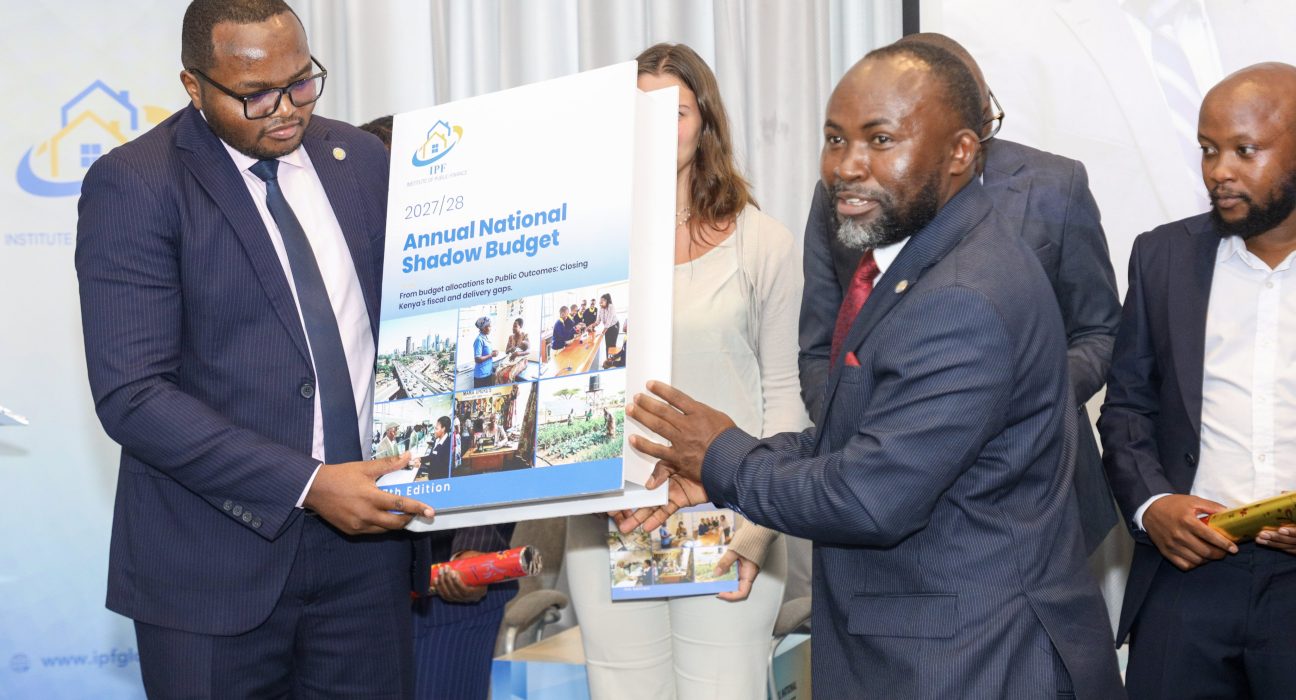
The Institute of Public Finance (IPF) has challenged the National Treasury and Parliament to restore credibility to Kenya’s budget process, warning that the FY 2027/28 Budget Policy Statement rests on overly optimistic growth and revenue projections that could derail service delivery in an election year.
Launching the seventh edition of its flagship Annual National Shadow Budget, IPF said its analysis shows the government’s plan assumes an economic growth rate of 5.1% well above the World Bank’s 4.4% and the African Development Bank’s 4.7% forecasts and tax revenue of KSh 3.1 trillion, roughly KSh 235 billion more than Kenya’s own ten-year record would support.
The launch comes as Parliament considers the 2027 Budget Policy Statement.
“Treasury is asking Parliament to approve spending that rests on growth and revenue figures above what independent forecasters and Kenya’s own record would support. In an election year, that is a risk MPs should not sign off without hard questions,” said Daniel Ndirangu, Chief Executive Officer of IPF.
Election Years Consistently Slow Growth
IPF’s analysis found that Kenya’s economy has consistently dipped around election years, undermining the Treasury’s optimism. Real GDP growth fell from 7.6% to 4.9% between 2021 and 2022, and from 5.9% to 4.9% between 2016 and 2017. The 2026 Budget Review and Outlook Paper and 2027 BPS do not show how the Treasury factored election risk into its projections.
On revenue, IPF proposes a more realistic tax target of KSh 2.9 trillion, translating to total revenue of KSh 3.7 trillion, down from the Treasury’s KSh 3.9 trillion plan.
Debt Servicing Consumes 40% of Revenue
The report paints a stark picture of Kenya’s fiscal position. Public debt stood at KSh 13.1 trillion — 70.4% of GDP — by June 2026, and has since risen to KSh 13.5 trillion, according to Central Bank of Kenya data. Interest payments alone are projected at KSh 1.31 trillion in FY 2027/28, about 40% of projected ordinary revenue — meaning for every KSh 100 the government collects, KSh 40 goes to servicing interest.
IPF also found that the government continues to borrow for consumption: about 21% of the KSh 983.7 billion borrowed in FY 2025/26 financed recurrent rather than development spending, contravening the Public Finance Management Act. Recurrent expenditure takes more than 70% of allocations, against a legal requirement that at least 30% go to development over the medium term.
Stalled Projects Pile Up
The shadow budget identifies 219 stalled, incomplete or delayed national government projects worth KSh 291.2 billion in FY 2024/25 — up from 188 projects worth KSh 240.5 billion a year earlier — plus another 77 delayed projects worth KSh 136.8 billion and 18 abandoned projects.
These delays carry real costs. On the Thwake dam alone, avoidable interest costs reached KSh 569 million and total project costs rose by about 32%.
“Behind each of these numbers is a county hospital waiting to be paid, a school asking parents to cover the shortfall, a household that needed health cover and was not enrolled,” Ndirangu said.
Health, Education and Social Protection Under Strain
IPF’s review found the Social Health Insurance scheme under severe pressure. In FY 2024/25, benefit claims on the Social Health Insurance Fund exceeded contributions by 59%, while the Emergency, Critical and Chronic Illnesses Fund received just 4% of its estimated requirement. The Health Insurance Subsidy Programme received about KSh 310 million against an estimated need of KSh 37–39 billion. By the third quarter of FY 2024/25, only 27% of private and 36% of faith-based facility claims had been paid.
In education, the State Department for Basic Education’s budget fell from KSh 155.4 billion in FY 2023/24 to KSh 132.7 billion in FY 2025/26. IPF calculates the Free Primary Education rate of KSh 1,420 per learner would need to rise to about KSh 1,833 by FY 2027/28 just to match its FY 2022/23 value. Households already carry an estimated 31% of education spending.
The National Safety Net Programme expanded from about 1.1 million beneficiaries in FY 2022/23 to about 1.8 million in FY 2024/25, yet its allocation dropped from KSh 42.7 billion to KSh 29.2 billion in FY 2026/27 and is projected at KSh 27.9 billion in FY 2027/28.
What IPF Wants Parliament to Do
The institute has tabled three demands ahead of the BPS approval:
- Anchor the budget on a credible macro-fiscal framework. Parliament should revise growth projections towards the 4.4–4.7% range, set tax revenue nearer KSh 2.9 trillion, and require a revenue-shortfall contingency plan before approving the FY 2027/28 estimates.
- Protect service delivery. Parliament should adjust education capitation for inflation, fold scattered bursary funds into capitation, move to a need-based formula and fund the Primary Healthcare Facility Fund, the Emergency, Critical and Chronic Illnesses Fund and the Health Insurance Subsidy Programme.
- Finish existing projects before starting new ones. Parliament should fund viable stalled projects and admit new projects into the budget only where ongoing ones are adequately financed.
IPF also calls for a risk-to-financing schedule from the State Department for Environment, Climate Change and Forestry, explained by Treasury in the BPS 2027, and for Parliament’s Budget and Appropriations and departmental committees to ask which prioritised programmes were cut, which outputs are forgone and which climate risks remain unaddressed.
“In summary, Kenya’s budget challenge is fundamentally one of credibility, prioritisation and accountability,” the report states.
The full Annual National Shadow Budget is available from the Institute of Public Finance.
Mzalendo Trust Launches 2026–2030 Strategic Plan to Open Up African Parliaments - Africa Watch News
November 26, 2026[…] IPF to Treasury and Parliament: Fix Kenya’s Budget… […]