

By Eddah Waithaka
At a major health conference this week, Kenyan officials and international researchers outlined a dual offensive against two of the world’s deadliest health threats: antimicrobial resistance (AMR) and vaccine-preventable diseases.
The government announced concrete steps toward regional vaccine manufacturing leadership while scientists presented evidence that clean water and immunization form a critical shield against drug-resistant superbugs.
Kenya Drives Toward African Vaccine Independence
Vision 2030 Delivery Secretariat Director General Mr. Kenneth Mwige declared Kenya’s commitment to becoming a regional hub for vaccine production, aligning with Africa’s goal of 60% vaccine self-sufficiency by 2040.
“Kenya has enough intellectual firepower to solve our challenges,” Mwige stated. “We are not so poor that we cannot do basic things. We have enough money to buy detergent, to buy brooms, to clean hospitals and collect rubbish. What we must do is cut waste and tie together the missing gaps between academia, research, government, and industry.”
He emphasized that the Kenya BioVax initiative marks a pivotal shift from mere distribution to developing domestic manufacturing capacity.
“We want to produce our own vaccine to solve our own health problems,” he said, highlighting plans for immediate, high-level meetings to translate existing research into actionable policy.
Environment is a Critical Front in the AMR Battle
The conference spotlighted the environment as a major reservoir for antibiotic-resistant pathogens.
Prof. Amy Pickering of the University of California, Berkeley, presented research showing a stronger global link between AMR burden and inadequate water and sanitation than with antibiotic consumption alone.
“Antibiotic stewardship is very important, but it will not solve the global AMR crisis alone,” Pickering said. She pointed to polluted water, waste sites, and agricultural land as transmission sinks, especially in drought-stricken regions.
“When there’s a famine, nobody cares about the quality of the water. People just want water. Inside that water are all the bacteria.”Her work in Western Kenya trials automated chlorination and other cost-effective water disinfection methods to break this environmental transmission route.
Also Read : https://africawatchnews.co.ke/kenya-launches-vaccine-independence-drive-at-major-science-conference/
Vaccines and WASH: A Preventative Power Couple
Researchers framed vaccines and Water, Sanitation, and Hygiene (WASH) as complementary, cost-effective preventative strategies.
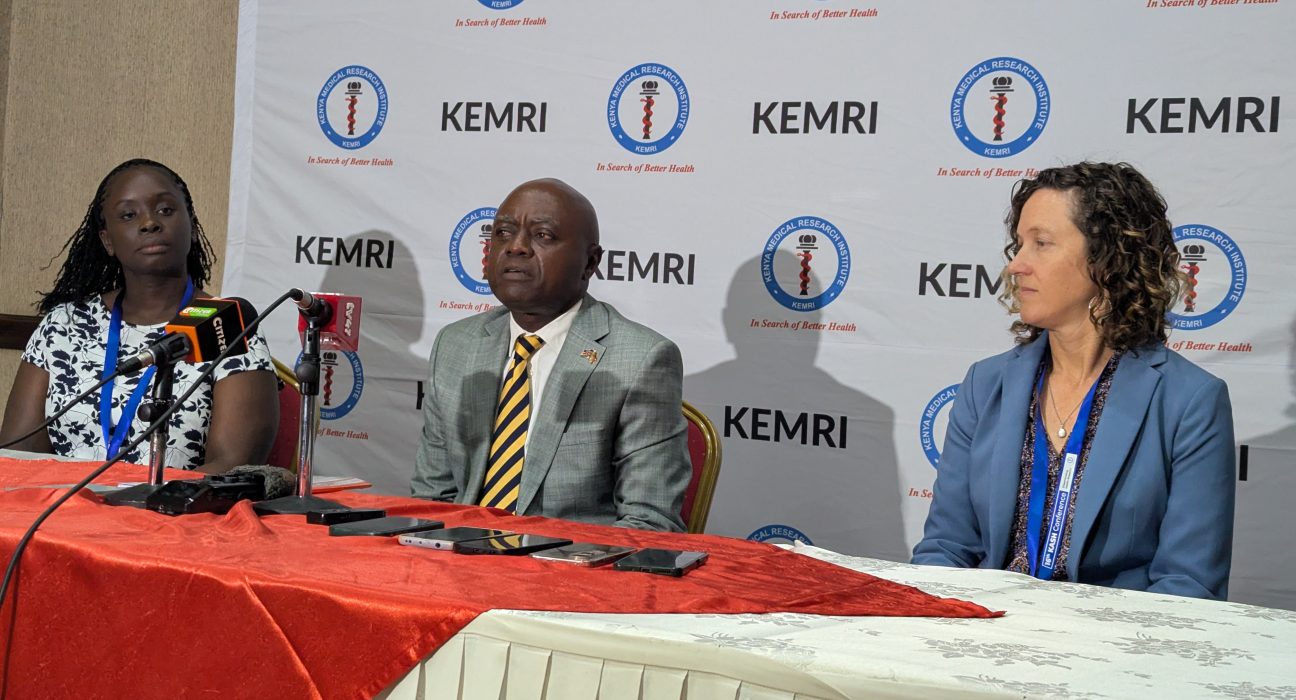
Dr. Anne Amulele of the KEMRI-Wellcome Trust Research Programme detailed the devastating impact of drug-resistant Klebsiella pneumoniae on neonates in Kenyan hospitals, where overcrowding and limited diagnostics exacerbate outbreaks.
“They are getting infected with bacteria that is very difficult for doctors to treat,” Dr. Amulele said. Her team is now pursuing a maternal vaccine to transfer immunity to newborns, calling it a critical tool to complement improved infection prevention in wards.
Prof. Pickering affirmed this synergy, “By preventing early-life exposures through vaccines and improved WASH, we reduce disease burden, decrease antibiotic use, and lessen the selective pressure that drives new resistant strains.” The dialogue moved beyond analysis to a urgent call for implementation.
Mr. Mwige stressed a “zero tolerance” approach to hospital-acquired infections and filth. “Disease spreads in dirty places. We have to clean our environments,” he asserted, directing county governments to prioritize water provision.
The consensus was clear. Kenya possesses the research, the institutions, and the policy framework to lead.
The path forward requires executing known solutions cleaning environments, securing water supplies, strengthening IPC, and investing in preventative immunization, to build a health system resilient to the converging crises of AMR and preventable disease.